
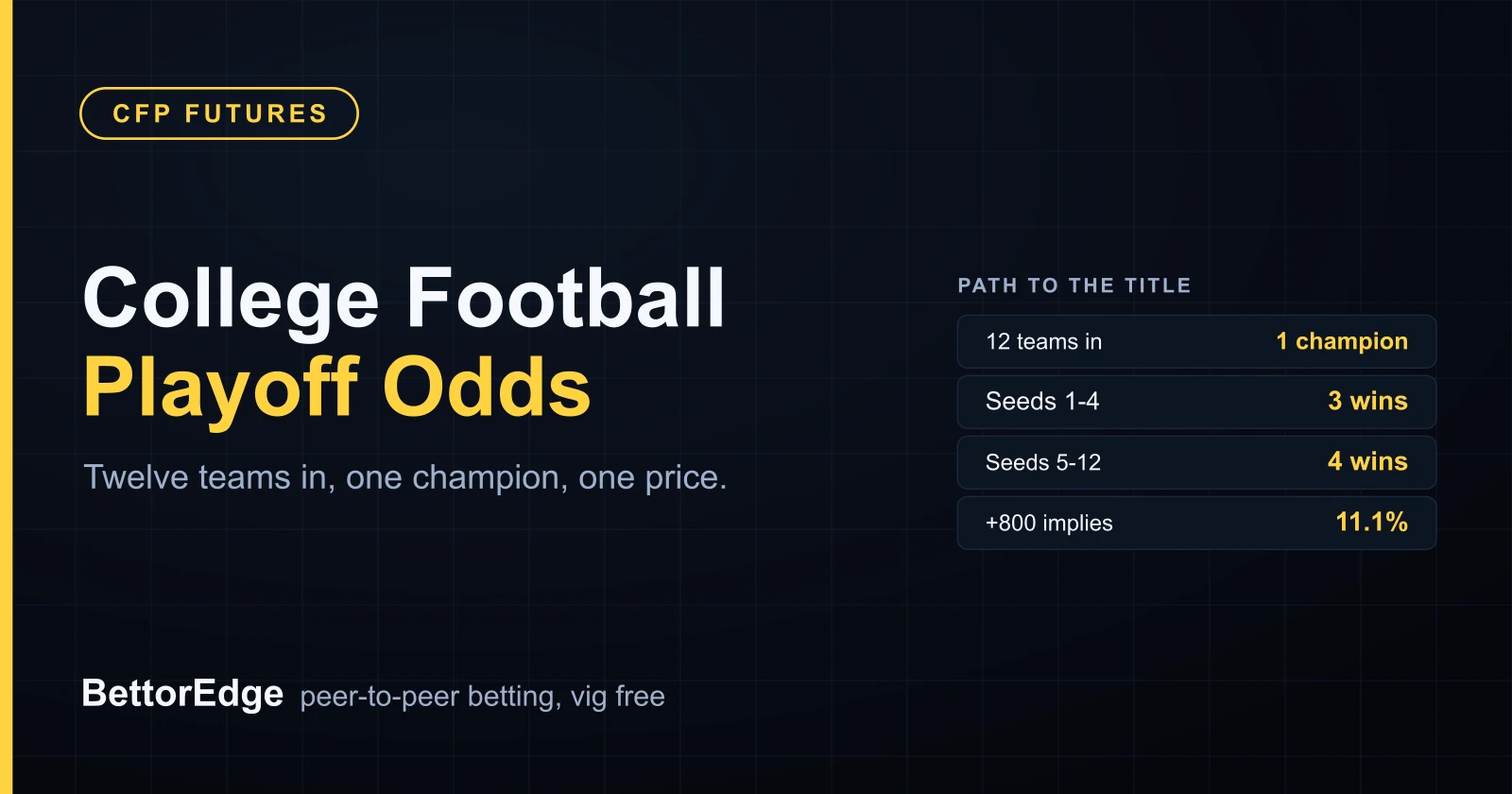
College Football Playoff odds are futures prices on the 12-team CFP bracket, and they come in two main markets: the odds to win the national championship and the yes or no odds to make the playoff field. A price such as +800 means a $100 bet returns $900 if the team wins the title, which works out to an implied 11.1% chance. CFP odds move all season as results, injuries and the committee's weekly rankings change each team's path, then settle into single-game spreads and totals once the bracket is set on Selection Day.
How college football playoff odds work
Every CFP price is quoted in American odds. A plus number shows the profit on a $100 bet, so +800 pays $800 profit, and a minus number shows what you risk to win $100, so -250 means risking $250 to win $100. To turn any price into the chance it implies, divide 100 by the plus price plus 100, or divide a minus price by itself plus 100.
There are three CFP futures markets most bettors use, plus the game lines that take over in December:
| Market | What it asks | When it settles | Typical prices |
|---|---|---|---|
| National championship | Will this team win the title game? | Title game, January 25, 2027 | Long: usually +300 or more |
| Make the playoff (yes/no) | Will this team finish in the 12-team field? | Selection Day, December 6, 2026 | Shorter: often minus money for favorites |
| Conference champion | Will this team win its league title game? | Conference title weekend, early December | Between the two |
| CFP game lines | Spread, total and moneyline on one playoff game | That game | Spreads and totals near -110 |
For the week to week markets running alongside all of these, the college football betting hub covers spreads, totals and moneylines on every game.
Odds to make the College Football Playoff
A playoff bid market asks one narrow question: does this team finish inside the 12? It is usually posted as a pair of prices, such as Yes -250 and No +200. Those imply 71.4% and 33.3%, which add up to 104.8%. The extra 4.8% is the margin the book builds in, and it is the first thing to notice on any yes or no board.
Because twelve teams get in and only one wins the title, the odds to make the CFP are far shorter than championship odds for the same team. That makes the bid market the better tool when your opinion is about one program's season, not about who wins it all. It also settles weeks earlier, when the final rankings come out on Selection Day, so your money is not tied up into late January.
Odds to win the college football national championship
A championship future is one team against the whole field. You take a price now, the ticket sits open all season, and it pays only if that team wins the final game. Prices are long because every FBS program is on the board somewhere and only one cashes. Here is what common title prices imply:
| Title odds | $100 bet returns | Implied chance |
|---|---|---|
| +300 | $400 | 25.0% |
| +500 | $600 | 16.7% |
| +800 | $900 | 11.1% |
| +1500 | $1,600 | 6.3% |
| +2500 | $2,600 | 3.8% |
| +5000 | $5,100 | 2.0% |
Add up the implied chances of every team on a championship board and the total lands well above 100%, because a board of more than a hundred teams stacks a small cut onto each price. You pay that overhang the day you bet, which is why futures are among the hardest markets in sports to beat.
Run your pool on BettorEdge.
Brackets, calcuttas, survivor pools and leaderboards, all in one place. Start a competition with your group and track it live on BettorEdge.
How the 2026 CFP format shapes the price
The College Football Playoff stays at 12 teams for the 2026 season, with a new rule for automatic bids. The champions of the ACC, Big Ten, Big 12 and SEC are in automatically. The highest ranked team from the Group of Six (the American, Conference USA, the MAC, the Mountain West, the Pac-12 and the Sun Belt) also gets a bid, whether or not it won its league. Notre Dame is guaranteed a spot if it finishes in the top 12 of the final rankings. The remaining places go to the highest ranked teams left in the committee's final rankings.
Seeding is straight off those rankings. The four highest ranked teams get the top four seeds and a first round bye, conference champions or not. Seeds 5 through 12 play a first round game on the higher seed's home field, and there is no reseeding after that. A bye is worth more than one skipped game: it also removes a December road trip.
| 2026-27 CFP milestone | Date |
|---|---|
| First CFP rankings | Tuesday, November 3, 2026 |
| Selection Day (final rankings, bracket set) | Sunday, December 6, 2026 |
| First round, at the higher seed | December 18 and 19, 2026 |
| Quarterfinals (Fiesta, Cotton, Rose, Peach) | December 30, 2026 and January 1, 2027 |
| Semifinals (Orange, Sugar) | January 14 and 15, 2027 |
| National championship, Las Vegas | Monday, January 25, 2027 |
That bracket produces two very different paths to the same trophy. A top four seed wins three games to take the title. A team seeded fifth through twelfth wins four, and the first is on the road. Two teams can carry an identical price while facing very different work.
A worked example: two teams at the same price
Say two teams are both listed at +800 to win the title. That implies 11.1%, because 100 divided by 900 is 0.111. One projects as a No. 2 seed with a bye, the other as a No. 5 seed with a first round game to play. Give both the same generous 55% chance in every playoff game and watch what happens.
Both listed at +800, which implies 11.1%. At 55% per game the bye team clears the bar at 16.6%. The 5 seed falls short at 9.2%.
The No. 2 seed wins three games at 55% each, which is 0.55 multiplied by itself three times, or 16.6%. The No. 5 seed wins four, which is 9.2%. Against an implied 11.1%, the same +800 ticket is a good price on one team and a bad price on the other, and nothing about the rosters changed. The bracket did the work.
CFP odds calculator: turning a price into a percentage
The discipline is the same for every CFP market. Turn the price into a percentage first, build your own number second, and bet only when the two disagree by enough to cover the margin. The odds converter does the first step in a second for any CFP price, and the implied probability calculator works the same math in percentages. For a team's path through the bracket, multiply its chance in each game it would have to win, as in the example above.
CFP betting lines: spreads and totals for playoff games
Once the bracket is set on December 6, every playoff game gets its own CFP betting lines: a point spread, a total and a moneyline, the same markets you bet on any Saturday. A CFP spread works like any other, so a team at -6.5 must win by 7 or more to cover. The guides to college football spreads and college football totals cover how those numbers are built.
Two things are different in the playoff. First round games are on the higher seed's campus, so home field is real in a way it is not at a neutral bowl site. And quarterfinal opponents are not known until the first round ends, so lines for the later rounds open only days before kickoff and can move quickly.
When to bet CFP futures, and why current odds move
The longest prices on a championship future usually sit in spring and summer, before preseason rankings harden opinion around the same handful of programs. The cost of betting early is information: you are pricing a team before you know about injuries, transfers and how a new quarterback looks. By October the price on any team that has looked good is already gone, and current CFP odds keep moving every Tuesday night when the committee's rankings drop in November.
The Heisman Trophy odds market behaves differently in one key way: it stops collecting evidence when ballots close in early December, while a College Football Playoff future grades into January.
Betting the College Football Playoff on BettorEdge
A ticket you hold for five months should not carry five months of house margin. BettorEdge is a peer-to-peer betting marketplace: you bet against other people instead of a sportsbook, so there is no house cut stacked onto every team on the board. You can take a price another bettor posts or set your own. More than 35,000 bettors use BettorEdge across 45+ states. Browse the college football board, compare prices on BettorEdge community odds, then open BettorEdge and bet the playoff peer-to-peer.
CFP odds FAQ
How do CFP odds work?
CFP odds are futures prices in American odds, such as +800, that show what a bet on a team pays if it wins the national championship or makes the 12-team field. To turn a plus price into an implied chance, divide 100 by the price plus 100, so +800 implies 11.1% and +2000 implies 4.8%. Prices move all season as results, injuries and the committee's rankings change each team's path through the bracket.
What are the odds to make the College Football Playoff?
Odds to make the College Football Playoff are yes or no prices on whether a team finishes inside the 12-team field when the final rankings are released on Selection Day, December 6, 2026. They are much shorter than championship odds because twelve teams get in and only one wins the title. A Yes price of -250 implies a 71.4% chance of making the field.
How many teams make the College Football Playoff in 2026?
Twelve teams make the College Football Playoff in 2026. The ACC, Big Ten, Big 12 and SEC champions get automatic bids, as does the highest ranked Group of Six team, and Notre Dame is guaranteed a spot if it finishes in the top 12. The four highest ranked teams get first round byes, and the national championship is played in Las Vegas on January 25, 2027.
What is the difference between CFP futures and national championship odds?
National championship odds are one CFP futures market, the one that pays only if your team wins the title game, while CFP futures as a category also include the yes or no market on making the field and the conference title markets that feed it. The playoff bid market settles on Selection Day in early December, about seven weeks before the title game. Because twelve teams make the field and one wins it, bid prices are far shorter.
What are CFP betting lines?
CFP betting lines are the point spread, total and moneyline posted on each individual College Football Playoff game once the bracket is set. A CFP spread works like any other, so a team at -6.5 must win by 7 or more to cover. First round games are played at the higher seed's home stadium, which matters to the line in a way a neutral bowl site does not.
When is the best time to bet College Football Playoff futures?
The longest College Football Playoff futures prices are usually available before the season, in spring and summer, and they shorten once preseason rankings and early results narrow the field. Betting early buys a better number but costs information, since you price a team before you know how its quarterback, health and schedule hold up. Betting later costs the number but lets you use evidence.
Cover image: Tech. Sgt. Anthony Hetlage, U.S. Air Force / Public domain, via Wikimedia Commons.
Run your pool on BettorEdge.
Brackets, calcuttas, survivor pools and leaderboards, all in one place. Start a competition with your group and track it live on BettorEdge.