
PropsMadness is a player prop research tool, not a picks service. It costs $25 a month, covers NFL, MLB, WNBA and NBA, and its whole job is to answer one question fast: how often has this player actually cleared this number in games that look like tonight's. The part worth knowing before you pay is that a real slice of it is free with no signup and no credit card, so you can decide whether the workflow fits you in about five minutes.
We opened the free MLB board on September 4, 2026 and worked a live prop through it. What follows is what the product does, what the free tier actually unlocks, the one screen that makes it worth using, and how to get the most out of the filters.
What PropsMadness actually does
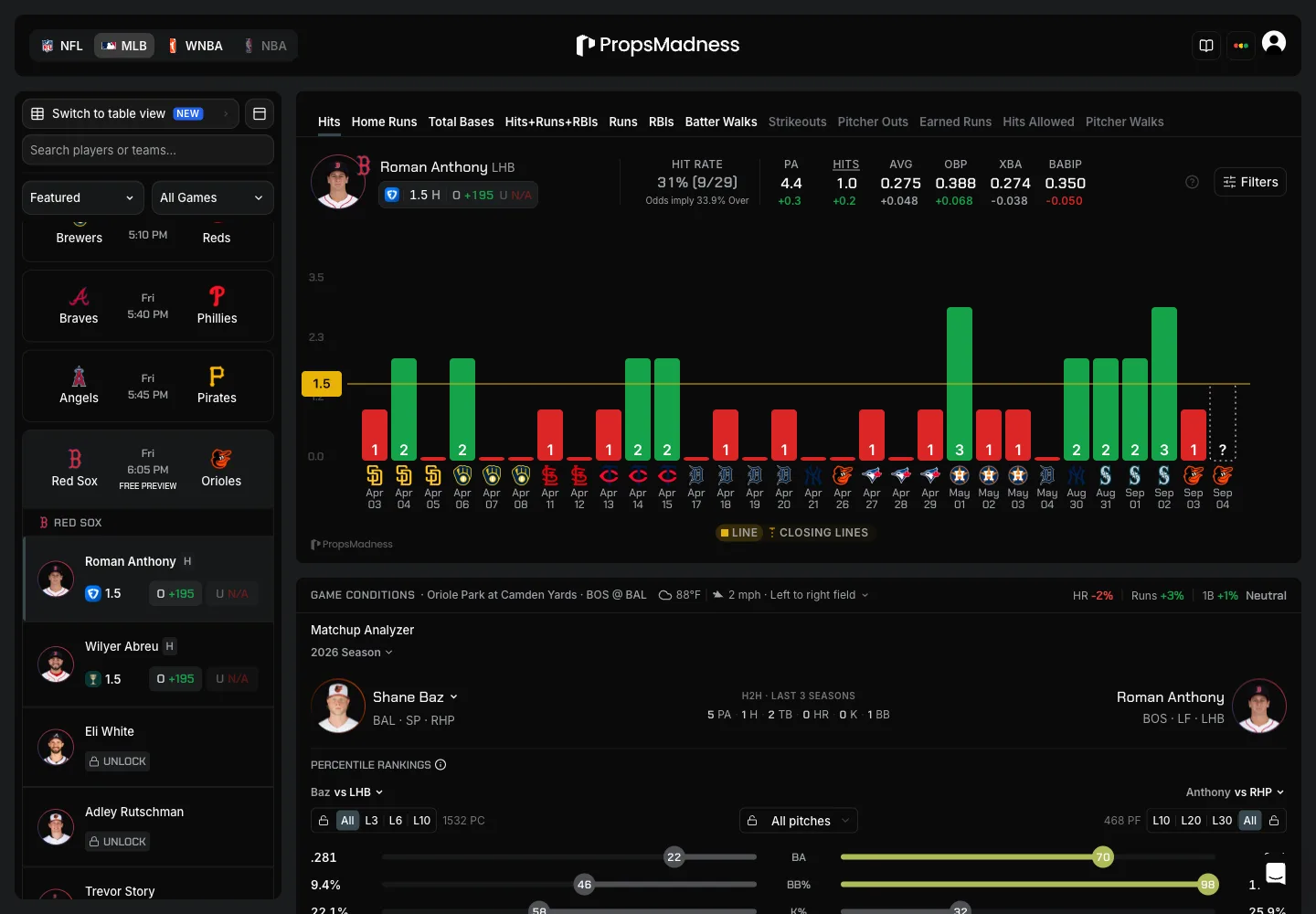
Pick a player, pick a market, and the app draws every game of that player's season as a bar against tonight's posted line, with a hit rate above it and a game-by-game table below. Around that chart sit three other tools: a Matchup Analyzer that puts the pitcher and batter side by side in percentile terms, a game conditions strip with park and weather, and a Line Shopper that compares the same prop across more than 40 sportsbooks.
What it will not do is hand you a play. There is no model projection, no star rating, no "edge" column ranking tonight's board from best to worst. The site's own FAQ says it does not give picks, and after an evening inside it, that is a fair description rather than modesty. You bring the read. It brings the evidence.
The free tier, tested
The free tier is unusually generous in one specific way: it needs no account at all. Open the MLB page and you land straight on a live board.
On the September 4 MLB slate that meant three free preview players and one free preview game, Red Sox at Orioles. Every other player on every other game carried an UNLOCK badge. Inside a free player you get the full thing: the hit rate, the game log, the season stat strip, the filter panel, the game conditions and the matchup analyzer. It is a real slice of the product rather than a screenshot of one, and the site describes it as free forever rather than a trial.
Bet the prop against people, not the house.
Books shade the popular props the hardest. On BettorEdge you take the other side of real bettors at a fairer number, and you are never limited for being right.
The one number that makes it worth using
Under the hit rate, PropsMadness prints what the current price implies. That single line is the best thing in the product, because it is the comparison most prop tools quietly leave out.
The prop we worked was a hits line at 1.5, with the over priced at +195 and the under not posted at that book. The chart showed a 31% hit rate across 29 logged games. Directly underneath: odds imply 33.9% over.
So the sample says one thing and the price says something slightly bigger, and the gap between them is the entire bet. A +195 over needs to land 33.9% of the time to break even, the player has cleared it 31% of the time, and on those two numbers alone there is nothing to take. Most tools would show you a green 31% bar chart and let you feel good about it.
The history is 2.9 points short of the price. Nothing to bet, and that is the useful answer.
That is the habit worth stealing whether or not you ever pay for the tool: convert the price to a percentage first, then ask whether your evidence beats it. Our implied probability calculator does the conversion on any number, and the same arithmetic sits behind every yardage prop on an NFL card.
The filters, and how to read them
The filter panel is where the subscription earns its money. You can set the season window (2024, 2025, 2026 or all), cap the sample at the last 10, 20 or max games, split by starting pitcher hand, and then stack situational filters grouped into suggested, opponent rankings, splits and raw stats, with a search box because there are far too many to browse. Baseball adds a game conditions strip: on the game we looked at, Camden Yards at 88 degrees with a 2 mph left to right wind, graded neutral at home runs down 2%, runs up 3%.
That depth comes with something to keep an eye on, and it is on the bettor rather than the product. Every filter you add makes the hit rate more relevant to tonight and the sample behind it smaller, and those two things pull in opposite directions. The Matchup Analyzer showed it plainly on the game we looked at: the head-to-head between the batter and that night's starter, across three full seasons, came to five plate appearances. PropsMadness labels it as five, which is exactly what it should do. The judgment about what five plate appearances are worth stays with you.
A useful working rule: add filters until the split genuinely describes tonight, then stop, and treat anything under about 20 games as a story rather than a finding. The tool gives you the game count next to every number, which is the piece you need to apply that rule. If there is one thing on our wish list, it is a nudge when a stacked filter set drops the sample below that line, because the product already does the harder half of this by printing implied probability.
Line Shopper, and the price it cannot see
The paid Line Shopper puts the same prop across more than 40 books on one row, refreshed constantly, so you can take the best of the posted numbers instead of the first one you saw. On a prop card at +195 against +180 elsewhere, that is real money over a season, and line shopping is the least glamorous edge in betting for a reason: it works without you being right about anything.
Two honest caveats. First, on the prop we pulled, the under simply was not posted at that book, which is a reminder that the shopper can only rank prices that exist. Second, the list is sportsbooks and pick'em apps. BettorEdge is not in it, so the peer-to-peer number is one you still check yourself, and it is usually the one worth checking, because on a community priced board you set the line rather than accepting the one posted with a margin baked in. A prop shopper is a tool for finding the least expensive version of a house price. It is not a tool for escaping house pricing.
What it costs
Pro is $25 a month, or $250 billed yearly, which works out to $20.83 a month and saves $50 against monthly. That unlocks every player in every league, the Matchup Analyzer and defensive insights, the Line Shopper, and a private Discord. Cancellation is self-serve and there is a seven day refund window. The company publishes a machine-readable pricing file as well, which is a small thing that says something about the people building it.
For a sense of scale on the price: at $25 a month you need roughly $300 of extra expected value a year for the tool to pay for itself, which at a 2% edge means turning over about $15,000. If you bet props three nights a week at $50 a pop, that is comfortably in range. If you bet props twice a month, it is not.
On the apps, the iOS listing sits at 4.9 stars from 63 ratings, published by DataLens d.o.o., with the most recent update in late August adding NFL 2026 support and multi-select pitch mix for MLB. The site cites a 4.7 Trustpilot score and more than 10,000 active users. Treat the 63 ratings for what it is: a young app with happy early users rather than a long track record.
Who it is for
Buy it if props are most of your betting volume, you already do your own research and you resent how long it takes, and you bet enough that a better price on every ticket compounds. The filter depth and the speed are genuinely good, and the hit rate against implied probability framing will make you a more honest bettor within a week.
Skip it if you want to be told what to bet, because it will not do that. Skip it if you bet props occasionally, because the free tier already covers a few players a day. And skip it if your main leagues are outside the four it covers.
The tool itself is only half the job. Research tells you what a number should be. What you do next is get the best available version of that number, and props are one of the most expensive markets on the board precisely because the margin on both sides is wide and few people shop it. Worth reading next to this: how we think about pricing a strikeout prop from scratch and the difference between props and fantasy football.
PropsMadness FAQ
How much does PropsMadness cost?
PropsMadness Pro costs $25 a month, or $250 billed yearly, which works out to $20.83 a month and saves $50 against paying monthly. Pro unlocks every player in every league, the Matchup Analyzer, the Line Shopper across more than 40 sportsbooks, and a private Discord, and the same prices apply to the in-app purchase on iOS. Subscriptions can be canceled at any time and the company offers a seven day refund window.
Is PropsMadness free?
There is a permanent free tier that requires no account, no signup and no credit card, and it gives you a few players per league each day rather than a time-limited trial of everything. On the MLB board on September 4, 2026 that meant three free preview players plus one free preview game, with every other player marked UNLOCK. Inside a free player you get the full hit rate chart, the complete game log, the filter panel and the matchup analyzer, so the free tier is enough to judge the workflow before paying.
Does PropsMadness give picks?
No. PropsMadness supplies data, filters, matchup context and sportsbook odds, and it never posts a recommended play, a projection or a ranked list of the night's best bets. That is a deliberate product choice rather than a missing feature, and it means the tool is only as good as the questions you bring to it. If you want to be told what to bet, this is the wrong purchase.
Is PropsMadness worth it?
It is worth it if props are most of your volume and you already do your own research, because the filter depth, the speed and the hit rate against implied probability framing genuinely save time and sharpen decisions. At $25 a month you need roughly $300 of extra expected value a year to break even on the subscription, which is realistic for someone betting props several nights a week and not realistic for someone betting them twice a month. The free tier costs nothing to test, so there is no reason to buy it blind.
What leagues does PropsMadness cover?
PropsMadness covers NFL, MLB, WNBA and NBA, with the first three live in early September 2026 and the NBA tab disabled until its season opens. Each league carries its own filter set, more than 50 per league, including shot zones and play types for basketball and pitch mix and park factors for baseball. There is no coverage of college sports, soccer, golf or hockey.
The short version
PropsMadness is a well built research database that respects the reader enough not to sell picks, and the decision to print implied probability next to the hit rate puts it ahead of most of the category. Used well it makes you a more honest bettor, because the price is always on screen next to the history. Test it free first, watch the sample size next to every split, and let the two numbers argue with each other before you bet.
You can look at the free board yourself at propsmadness.com. Then, when the research points somewhere, the number you take matters as much as the read that got you there. On BettorEdge community odds you set your own price and get matched against another real bettor instead of paying a house cut on both sides. Open BettorEdge and price your next prop yourself.
Bet the prop against people, not the house.
Books shade the popular props the hardest. On BettorEdge you take the other side of real bettors at a fairer number, and you are never limited for being right.